ERP Impact on Private Educational Institutions
Today's private schools' function in a setting that demands excellence in administration, communication, and overall experience in addition to academics. Everything needs to go smoothly, from handling applications and fees to keeping academic records and guaranteeing parent involvement.
At this point, ERP for private institutions becomes more than just a technology advancement, it becomes a strategic requirement.
Adopting cutting-edge solutions like Odoo ERP for private schools and private school administration software is now necessary for growth and sustainability due to growing competition and parental and student expectations.
Presenting Odoo ERP for Private Establishments
Odoo ERP for private institutions stands out among the other ERP options because of its extensive features, flexibility, and cost.
Odoo is an open-source ERP platform that enables organizations to tailor the system to meet their own requirements.
What is ERP for Private Institutions?
A unified digital system called ERP unifies all company operations onto a single platform.
Schools, colleges, and academies may handle everything from admissions and academics to finance and human resources all inside a single system when ERP for private institutions is customized for education.
ERP systems, in contrast to simple software tools, offer:
- In real time access to data
- Managing repetitious tasks
- Enhanced departmental coordination
- Advanced data analysis and reports
The Problems Private Institutions Face
There are significant differences between private and public institutions. They usually have higher expectations, increased rivals, and a stronger focus on image and productivity.
Among the main difficulties are:
- Processing massive amounts of student data
- Promoting prompt fee collection and financial openness
- Keeping lines of communication open with parents
- Managing admissions effectively
- Providing excellent academic tracking
Spreadsheets, manual registers, and disjointed tools are examples of traditional systems that fall short of these requirements. ERP for private institutions successfully closes this gap.
The Need for Professional Administrative Software in Private Schools
A private organization in the present era cannot depend on antiquated practices. The complexity of operations and the requirement for efficiency make specialized private school administration software necessary.
Important Justifications for ERP Adoption:
1. Consolidated Functions
Academic, administrative, and financial activities are all controlled from a single platform.
2. Simplicity of Time
Teachers and staff can save time by reducing their manual effort through automation.
3. Improved Interaction
Unified communication solutions let parents, educators, and administrators remain in touch.
4. Security of Data
Access to sensitive data is restricted and kept safe.
5. Growth
The system adjusts to growing demands as the organization expands.
How to Select the Best ERP Solution
Success depends on choosing the appropriate ERP system.
1. Determine Your Needs
Recognize your institution's particular requirements.
2. Assess Features
Make sure all necessary features are covered by the software.
3. Look at the Individualization Choices
Choose a system that can be altered to suit your needs.
4. Consider Your Budget
Look for a less expensive solution like Odoo.
5. Work Together with Experts
Collaborate with skilled ERP execution specialists.
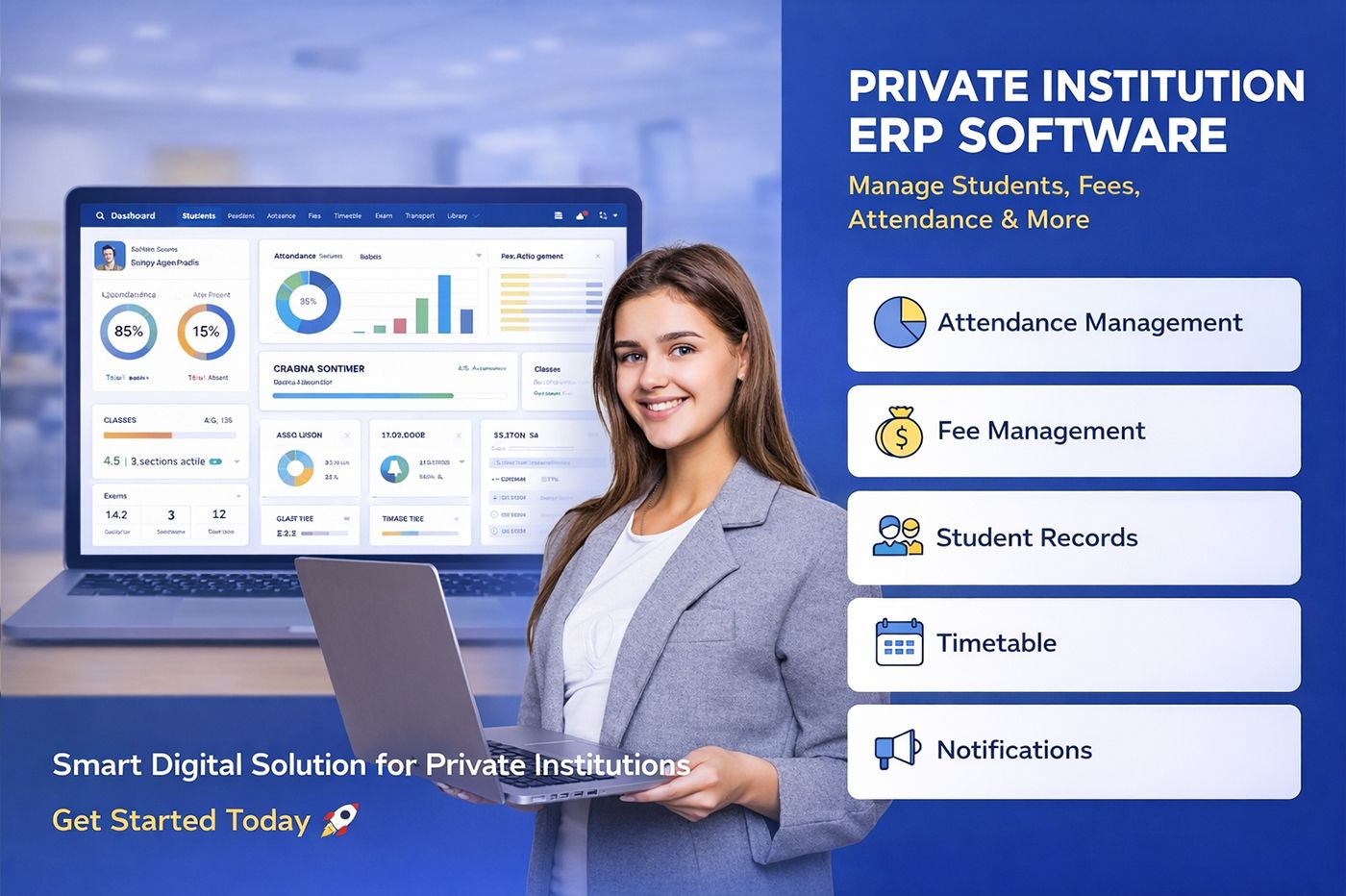
Essential Elements of Software for Private School Management
Many variables aimed at simplifying operations are available in a robust private school management software package.
1. Management of Admission
automates every step of the admissions process, including enrollment and application.
2. Information System for Students
Keeps thorough student records that include personal information, attendance, and academic achievement.
3. Management of Fees
effectively manages reminders, fee collecting, invoicing, and payment tracking.
4. Monitoring Attendance
Reduces mistakes and manual labor by digitally recording attendance.
5. Management of Examinations
Easily administer tests, record grades, and create report cards.
6. Tools for Communication
Turn on instant messaging via email, SMS, or app alerts.
7. Payroll and HR
Oversee personnel files, pay, and performance reviews.
What Is Special About Odoo ERP?
1. Layout in Modules
Institutions can begin with simple modules and add more as necessary.
2. Personalization
Workflows are different in every private institution. To meet those needs, Odoo offers full modification.
3. Easy-to-use Layout
Staff and administrators will find it easy to implement because to the user-friendly design.
4. Capabilities for Integration
Accounting, HR, CRM, and communication systems are all easily integrated with Odoo.
5. Economical
Odoo is quite cost-effective when compared to other ERP solutions
How Odoo ERP Enhances Management of Private Institutions
Private organizations that use Odoo ERP experience quantifiable gains in every aspect of their operations.
1. Easy Admissions
The admissions process is made simpler with online forms, automated workflows, and speedy approvals.
2. Effective Fee Collection
Reminders and automated invoicing guarantee prompt payments and cut down on delays.
3. Improved Academic Administration
Lesson plans, attendance, and grading can all be effectively managed by teachers.
4. Presenting in Actual Time
For better decision-making, administrators have immediate access to data and reports.
5. Enhanced Involvement of Parents
Through specialized portals, parents are kept up to date on their child's development.
A Day in a Digitally Revolutionized School
Consider a normal day at a private school that uses ERP:
- A notification regarding their child's attendance is sent to the parent.
- Grades are updated immediately into the system by a teacher.
- The administrator monitors fee payments in real time.
- Performance reports are immediately reviewed by the principal.
Only a strong ERP for private entities can provide this degree of effectiveness and openness.
Advantages of ERP Implementation in Private Organizations
1. Increased Effectiveness
Technology allows workers to spend more time on their main responsibilities.
2. Better Decision-Making
Having access to current information allows one to make informed decisions.
3. Greater Transparency
Customer trust is increased by having clear records.
4. Financial Savings
Operations costs are decreased with less paperwork and manual labor.
5. Edge in the Market
ERP-adopting organizations stand apart in the marketplace.
Why Odoo ERP Is Preferred by Private Institutions
Odoo is frequently selected by private organizations because it provides:
- Adaptability to specific needs
- Durability for expanding organizations
- All the features you need on a single platform
- Powerful ecology of support and community
The Odoo-based private school administration software promises that organizations can successfully handle operations without depending on several technologies.
Avoiding Typical Implementation Obstacles
ERP systems have many advantages, but without careful preparation, adoption can be difficult.
1. Opposition to Change
Employees could be reluctant to use new technology. Support and training are essential.
2. Migration of Data
Careful planning is necessary when transferring data from outdated systems.
3. First Investment
The long-term ROI outweighs the seeming high initial expenses.
Many of these obstacles can be addressed by private institutions by selecting an adaptable solution like Odoo ERP.
ERP Trends for Private Institutions in the Future
Technology and innovation will shape ERP for private Institutions in the future.
1. Integration of AI
Forecast student performance and offer tailored learning insights.
2. Accessibility on Mobile Devices
ERP systems that prioritize mobile devices will become commonplace.
3. Solutions Based in the Cloud
Cloud ERP will lower infrastructure expenses and provide remote access.
4. High-Level Analytics
Decision-making will heavily rely on data-driven insights.
Strategy for Successful Implementation
An effective ERP deployment entails:
- Preparation and review of requirements
- Choosing the appropriate ERP system
- Personalization and setup
- Migration of data
- Onboarding and training
- Constant observation and development
Digital Transformation's Competitive Advantage
Adopting ERP systems gives private organizations a big edge.
They can:
- Provide parents and kids with improved services
- Become more productive
- Make more informed choices
- Develop a solid reputation in the field of education
Adopting private school administration software is now more about staying ahead in a competitive sector than it is about efficiency.
Private schools must change to keep up with the fast-growing importance of technology in education. The introduction of ERP is a calculated step that improves overall performance, efficiency, and transparency for private institutions.
A strong private school management software program guarantees smooth departmental cooperation and optimizes complicated procedures.
Odoo ERP for private institutions is a strong, adaptable, and reasonably priced option. It is perfect for modern educational institutions because of its capacity to combine multiple functions into a single platform.
By adopting ERP solutions, private schools can differentiate themselves in an increasingly competitive market by improving their learning environment and streamlining their operations.